Showing posts with label landscape. Show all posts

Sunday, April 26, 2009

Photoshoot near Quirianopolis, Goias, Brasil

I managed to take a week off while in Sao Paulo to go visit the Fazenda Engenho São Francisco near Quirianopolis. Here are my tips and mistakes made while shooting pictures in a farm.

Here is the equipment taken

Here was my journey:

image Ireland to Brasil
Map picture
then to Goiania and Quirinopolis in Goias State
 image


Fazenda Engenho São Francisco  (click on the link and zoom in you can actually see the cattle)

BTW for Olympus RAW file usage with GPS I recently discovered GeoSetter, great tool that can work with the .ORF files, write the .xmp card or directly into the file to accommodate GPS data. Highly recommended.


Most Important tip…

Always talk to the person that runs the place day in and day out. They will give you good tips around the behavior of some of animals, which ones are approachable, and which ones to be careful (I managed to piss off a cow with her calf and it wasn't pretty)
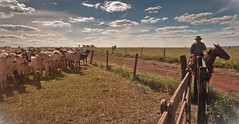
Bola and cattle

Learn beforehand what kind of animals will you get to see (in my case was mostly cattle but managed a nice surprise to see exotic animals.
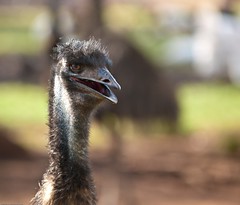
Emu look

For cattle, learn what type of cattle it is you will be seeing, behavior will change depending on the breed and how is managed by the ranch.

The gang

If you want cattle to get close to you, as I wanted a very low close-up shot of some grown cows or bulls you need to get into the containment area, get down or sit down on the floor and wait. Cattle can be very curious and only takes one to come closer, for the other ones to follow. Be very careful once they are close, sudden moves can make them jump (very high) and you don't want to get stomped or worse your equipment be crushed
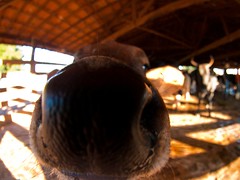
Courious calf

Clothes: depending on where you are going, will vary your clothing, but regardless of weather bring very old dirty jeans. If you can manage some cheap boots do as well, as you have to be ready to step, kneel and sit on cow dong, piss and milk and dirt. Same goes for your camera bag, be ready for it to get dirty and gnawed by curious calves
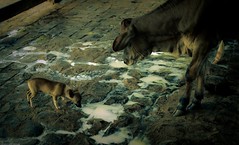
Spilled milk

Bring your equipment for landscape photography, either on hills or flat land ranches tend to be in open spaces and you can capture great sunsets, sunrises and cloud formations.
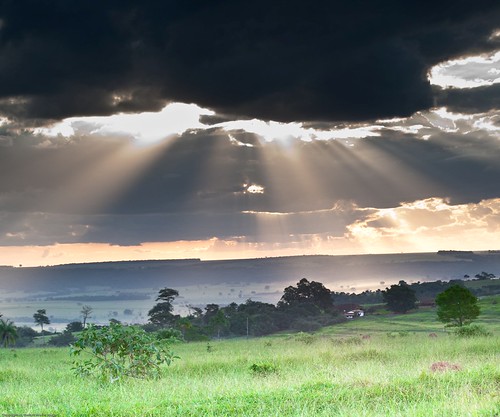
Storm in Sta Cecilia

Get up early, not only because of the great light during that time, farm work starts at 5am the animals are quite awake and is the time before a lot of the cattle is being driven to eat at the grass lands. Also in the case of Brasil is when you can manage best to carry all your equipment with the sun.
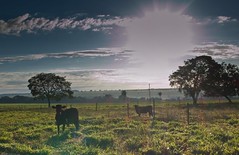
Sunrise

If you get to ride a horse: Taking pictures on top of a horse is not so hard if you: a) Have IS on your lense or the camera 2) Shoot either using manual or at least shutter priority mode. The faster the horse, the faster the shutter speed if you want sharp images.

Find out what other ranches around the area you are visiting. We managed to visit a neighboring ranch that sells and raises exotic animals and manage to get great shots. They were very nice and let us walk inside the containment area and take our time on getting to know the animals and wait for the best shots.(So here is a free commercial  :) )

Also depending on where you are you might manage to view animals not very common to your area, I was very intrigued by Pipoca a cateto pork which tend to be very mean, except him.
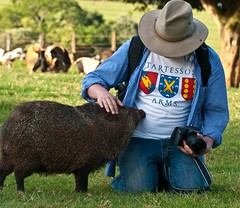
Amigo Pipoca

Missed opportunities:

Some of the shots or things missed:

Not all the cattle behaves the same, while buying and marking some recently purchased cattle, a bull wouldn't come into the containment area, 4 workers chase after him but he managed to jump a fence of at least 1.5 meters, it would have been a great shot.

I should have brought my Manfrotto tripod I missed some good sunset and late opportunities because of not bring it. I have the 190X which is not too heavy but maybe I should invest on a gorillapod or at the very least a smaller tripod I can travel easier

I was so concentrated on the cattle, that I missed some good opportunities for portraits with the workers at the ranches. Brasilians tend to be very open on getting their picture taken and the clothes they wear are very distinct and interesting and could make great portrait subjects.
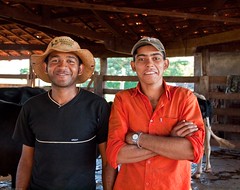
Fazenda hands

Same as above, make sure to take pictures for remembering the trip, take pictures with family and friends, not everything is about getting the best shot.

See the rest of the shots here

Wednesday, August 27, 2008

Tips on... <Urban Landscape>

Early bird catches the worm

Prospective perspectives

Your perspective should differ depending on the shape and form of what's before you. For square buildings try to shot at a 40-60 degree angle to avoid a flat image, for domes or curved shapes its important to feature some background in order to the viewer to appreciate the form

Up and coming

Should not only be dedicated to the built environment, take a look around you and see what's happening construction wise. Documenting a building going up can make a for a great addition to your portfolio, while renovations are always an interesting subject to shoot

Permission to shoot

Be aware that many places require you to possess a licence before you can shoot on its grounds. Just like a model release form these building release forms cover how the images will be used and determines who holds the copyright. You can often negotiate to exchange images in return for a photo pass.

Angle attack

The best way to find new approaches to shooting well known buildings is to approach them from all angles, Search for unusual features or crevices that are rarely seen in the usual publicity shots of that place, and go in from that angle instead. Look out for patterns, reflections and textures to really bring out the buildings characteristics

Once you have found a location the next stage is being able to approach your scene in a variety of ways photographically, playing on perspective, viewpoint and light. Look for places that will look great close up as abstract images but also will produce impact as a full frame image

Some prefer to shoot from a distance some prefer to accentuate angles and other shoot for pattern or repetition.

Place yourself where the reflective rays do not directly shine onto your lens, or else your images will be a complete whitewash. Sometimes a polarizing filter will help you manipulate reflective scenes to your advantage. It will enable you to suppress subtle reflections and darken any blue sky mirrored in the building's glass.

Many prestigious buildings will be flood light at night, which represents some challenges, The bright light coupled with harsh shadows makes it a tricky subject to choose. Underexpose then tweak if needed. Is better also to bracket your shots. Find a midtone and then use spot metering

Panoramas

Lens selection

Opt for a standard len to ensure threre is no distortion, Wide angle lenses are more susceptible to this than normal lenses

Steady now

Choose a tripod with a panning head to ensure a smooth transition that is level and lined up correctly for each shot

Shoot in line

Being taking your shots starting from one side and progressing to the other. Make sure you overlap your last shot by a third each time, to ensure they line up afterwards.

Make it merge

Upload your shots in Photoshop or a similar program. No matter the program, some editing will be required to make the images match

Use manual

To ensure that no readings are changed between lights, such as fstop, shutter speed, etc that could alter one of the shots you can use and make it look different from the rest

del.icio.us Tags: ,,,

Exotic Landscapes

Tricks of the light

  • If you are traveling anywhere near the coast or desert, the exotic idyll of white sands and turquoise skies although photogenic will present the photographer with a multitude of hazards. They key is to be aware of the suns position.
  • In locations where cloud cover is sparse, intense sunlight will be detrimental to the level of detail in your image.
  • Adjust EV compensation up by one or two stops, or use exposure bracketing to cover yourself against inaccurate metering in tricky lighting scenarios
  • Early morning light is perfect for highlighting contours and textural formations of a deser landscape, emphasized even more by a low shooting position and wide angle lens
  • The low position of the sun and quality of natural light later in the day will give shots an atmospheric appearance, casting long shadows and adding depth to scenes such as rock formations and layered landscapes. Landscapes will also take on a warmer color tone at the beginning and end of the day, compared with the cool blue cast of midday

Wide Open

  • A standard wide angle lens at 35mm equivalent focal lent of 43-60mm or a super wide angle lens of 24-42mm will work to capture every last detail while making the most of the sjy and foreground
  • Place the horizon in your frame according to the interest that the sky and foreground each hold - they must wor kwell together or not at all-

For coastal areas

  • Using fast shutter speeds higher than 1/250 secs will freezse the motion of waves and sea spray. In contrast, slow shutter speeds of less than half a second will blur the water and soften the scene. If this is where your traveling interest lues then the addition of a polarizing filter to your kit bag will help you improving the color and contrast of your images, and will reduce the glare caused by reflection. A tripod is a most on all of this situations
  • The inclusion of a human element into a typical landscape photograph can give a striking sense of scale to a place. Focus your lens on the person in the frame, but employ a wide aperture to ensure sharpness from front to back.

del.icio.us Tags: ,,,

Places I've shot in